
TRIPs
Methodology

"Climate time bomb is ticking," said United Nations Secretary General Antonio Guterres. The speed of temperature rise in the past 50 years is the fastest in the span of 2000 years.The current CO2 concentration level has been the highest in the past 2 million years. The only way to defuse the bomb is to limit the rise in global temperature to 1.5°C before the end of this century.
Now that “1.5°C” has become the consensus with scientific basis, it is vital that corporations commit to carbon reduction based on that.
For most corporations, each of their emissions seem insignificant in comparison to global emissions. Thus, why don’t we scale it up to a global scale? We examine the similarities between corporations’ emissions and the 1.5°C pathway by comparing corporations’ carbon emissions pathway and the IPCC AR6 future scenarios.
This is the core value of TRIPs. “Scale-up” is one of the most important steps of TRIPs.
TRIPs scale up corporations’ future carbon emissions pathways to align with global carbon emission pathways, and then involve the Absolute Global Temperature Potential (AGTP) to gain the final result.
TRIPs Methodology - Introductory Video

TRIPs Calculation Steps
Categorization
STEP 1 Categorization
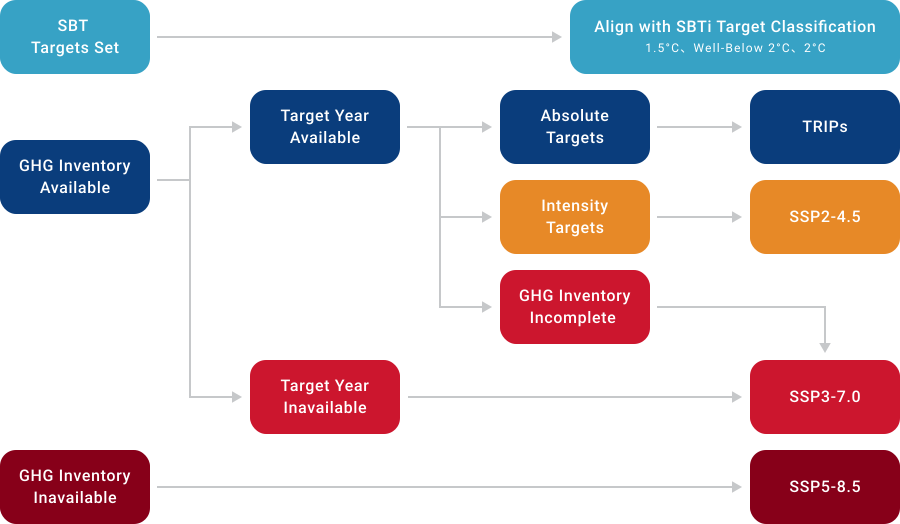
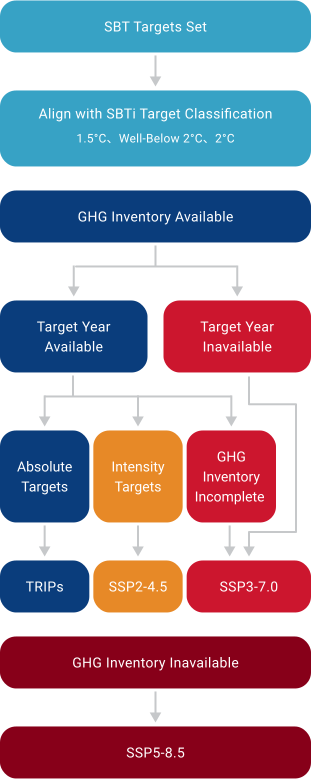
Before determining TRIPs level, we will categorize corporations based on their carbon reduction targets and past GHG emission amounts.
Category 1
Corporations that have their targets reviewed and validated by the SBTi. We mark them with levels aligned with SBTi target classification without further calculation.
Category 2
Corporations without carbon reduction targets.
These corporations can be further differentiated by whether they have GHG inventory prepared or not. If GHG inventory is not available, they will be marked as SSP5-8.5 (approximately 4.5 °C) according to IPCC AR6 future scenarios. If GHG inventory is available, they will be marked as SSP3-7.0 (approximately 3.5 °C) according to IPCC AR6 future scenarios.
Category 3
Corporations committed to RE100 and/or a net-zero target but lacking near-term and mid-term targets. We mark them as SSP2-4.5 (approximately 2.5°C) according to IPCC AR6 future scenarios.
Category 4
Corporations having near-term, mid-term, and long-term targets but do not have their targets reviewed and validated by the SBTi. It does not matter if they are committed to a net-zero target or not. This category requires the most complicated calculations, which is elaborated in the following:
- Conduct prediction and pathway tracing according to corporations’ self-proclaimed carbon reduction targets.
- Standardize corporations’ past emissions.
- Scale up corporations’ emissions data to align with the global emissions database. This step is meant to magnify corporations’ emissions to a global scale. In this way, we can gain an evident TRIPs level instead of gaining an insignificant number.
- Input the scaled-up corporation emission data into AGTP and obtain the final TRIPs result.
IPCC AR6 Five Future Scenarios
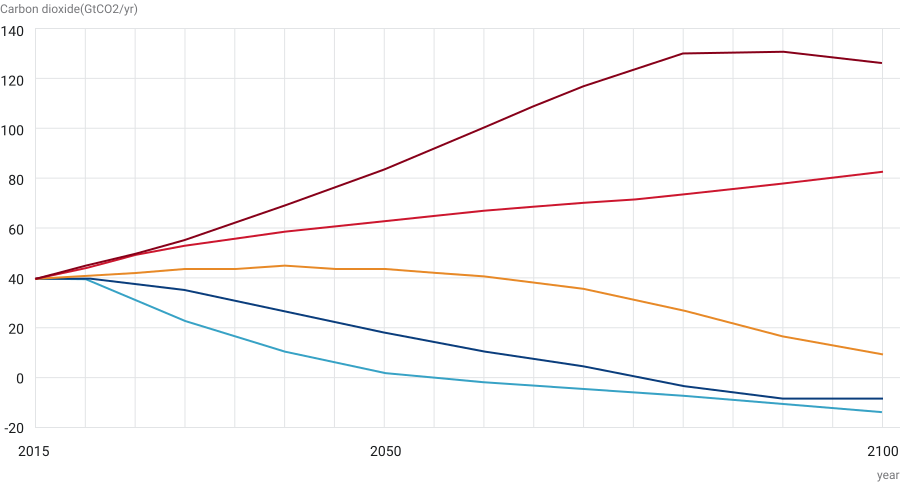
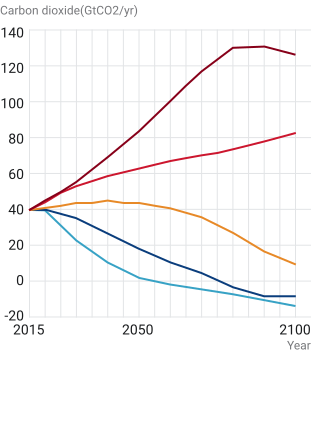
- SSP5-8.5
- SSP3-7.0
- SSP2-4.5
- SSP1-2.6
- SSP1-1.9
Source/IPCC Sixth Assessment Report
How to determine TRIPs levels
Trace Out the Pathway
STEP 2 Trace Out the Pathway
Trace out carbon reduction pathways for corporations in the fourth category above. We use self-proclaimed carbon reduction targets to present the carbon reduction trend.
How to trace out corporations’ carbon reduction pathways
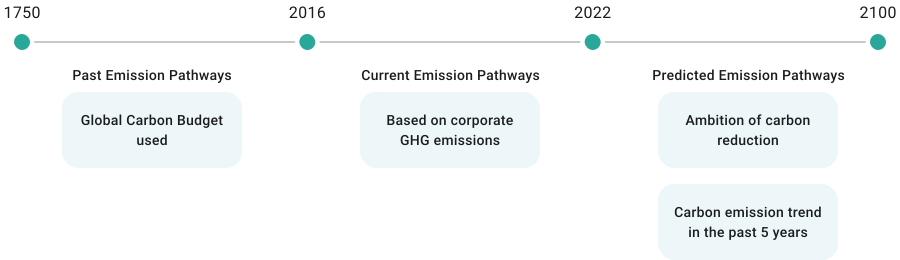
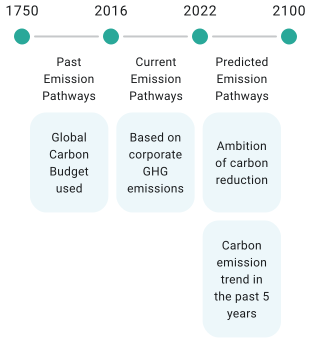
We start the trend line at corporations’ self-proclaimed base year. It will not be earlier than 2016 in order to align with the Paris Agreement. For example, if corporation A proclaims that it uses 2014 as their base year, TRIPs will still adopt 2016 as the base year for it.
The predicted pathway will not end until emission amount is reduced to 10% of the base year emission. If this is met before the year 2100, it will remain like this until 2100. If the corporation is committed to a net-zero target, its pathway will end with 0 emission amount in the end.
Standardization
STEP 3 Standardization
Standardize the emission amount on corporations’ self-proclaimed base year. We set the base year emission amount as 100%, and then transform emission amount of the subsequent years into percentages using base year emission amount as the denominator.
An example of how to transform emission amount of the subsequent years into percentages
| Year | 2014 | 2015 | 2016 | 2017 | 2018 | 2019 | 2020 | 2021 |
|---|---|---|---|---|---|---|---|---|
| Scope 1&Scope 2 Emissions | 1,200 | 1,150 | 1,194 | 1,238 | 1,330 | 1,440 | 1,210 | 1,009 |
| Base Year 2016 | 100% | 104% | 111% | 121% | 101% | 85% | ||
| Base Year 2018 | 100% | 108% | 91% | 76% | ||||
| Base Year 2019 | 100% | 84% | 70% | |||||
| Base Year 2020 | 100% | 83% |
Scale Up
5&6
STEP 4 Scale Up
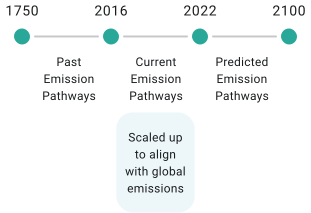
Scale up corporations’ carbon emission data to align with the Global Carbon Budget (GCB) and magnify corporations’ carbon emission scale to a global emission pathway level. The base year remains as self-proclaimed by corporations, and the endpoint would be the year 2100.
Corporations’ carbon emissions are scaled up to aligned with global emissions

5&6
Involve AGTP and Result
STEP 5&6 Involve AGTP and Obtain the Final TRIPs Result
Input the scaled-up corporation emission data into AGTP and obtain the final TRIPs result. The result manifests to what extent will the temperature rise by the end of the century if the corporation sticks to the self-proclaimed carbon reduction target and emission amount.

 The change in global mean surface temperature at a chosen point in time in response to a 1 ton pulse emitted today.
*Absolute Global Temperature Potential (AGTP) is an international methodology adopted by IPCC AR. It is also the core methodology adopted by TRIPs.